
Video is now the default ad format for small businesses: according to Wyzowl’s State of Video Marketing report, 91% of businesses use video as a marketing tool, and most video marketers say it has directly helped them increase sales. At the same time, AI video tools have changed the economics. A small business that once could afford one polished video a quarter can now test ten variations a week. But more videos don’t automatically mean more customers. Here’s the practical system I use to scale AI video ads for small business clients without burning their budget.
Why AI video ads work for small businesses
- Lower production cost: scripts, voiceovers, captions and edits that took days now take hours.
- More creative testing: ad platforms reward fresh creative, and AI makes variations cheap.
- Faster localisation: one video can become versions for different cities, languages and offers.
The catch: AI makes it easy to produce generic content. Small business clients win when their videos feel specific, local and trustworthy.
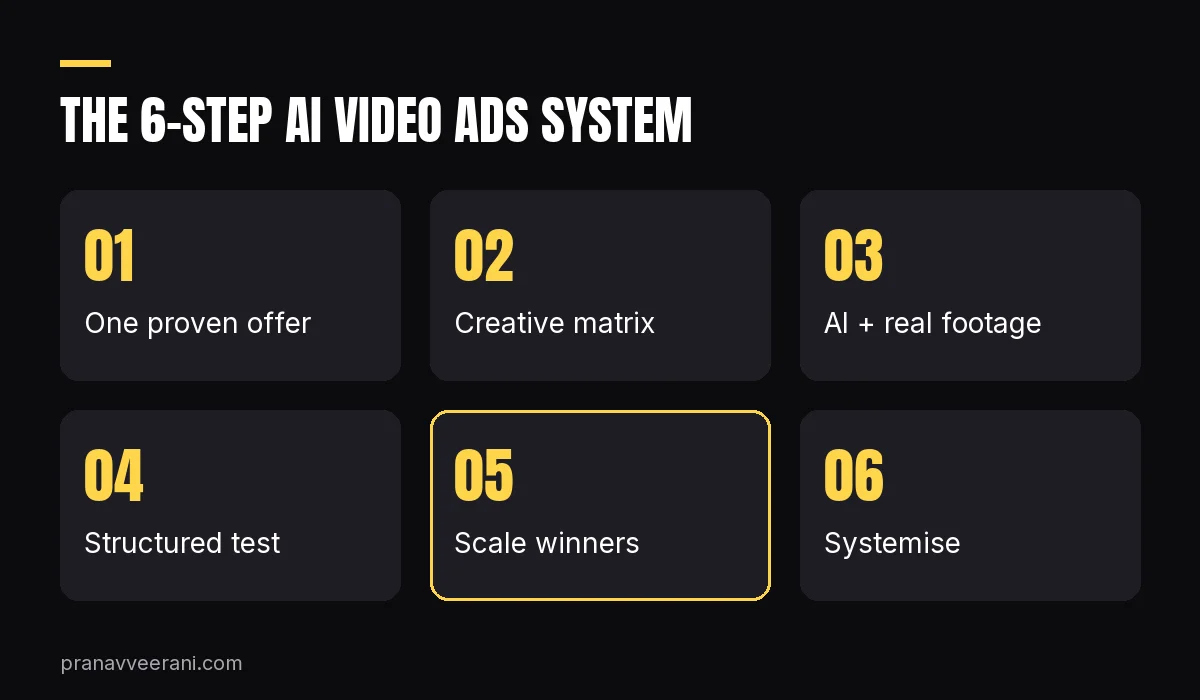
Step 1: Start with one proven offer, not ten ideas
Before you generate anything, agree on one clear offer with the client: a free consultation, a first-visit discount, a demo or a quote. Scaling a weak offer only scales the losses. Check what already converts through their website, WhatsApp or walk-ins and build from that.
Step 2: Build a creative matrix
Instead of making random videos, plan variations on purpose:
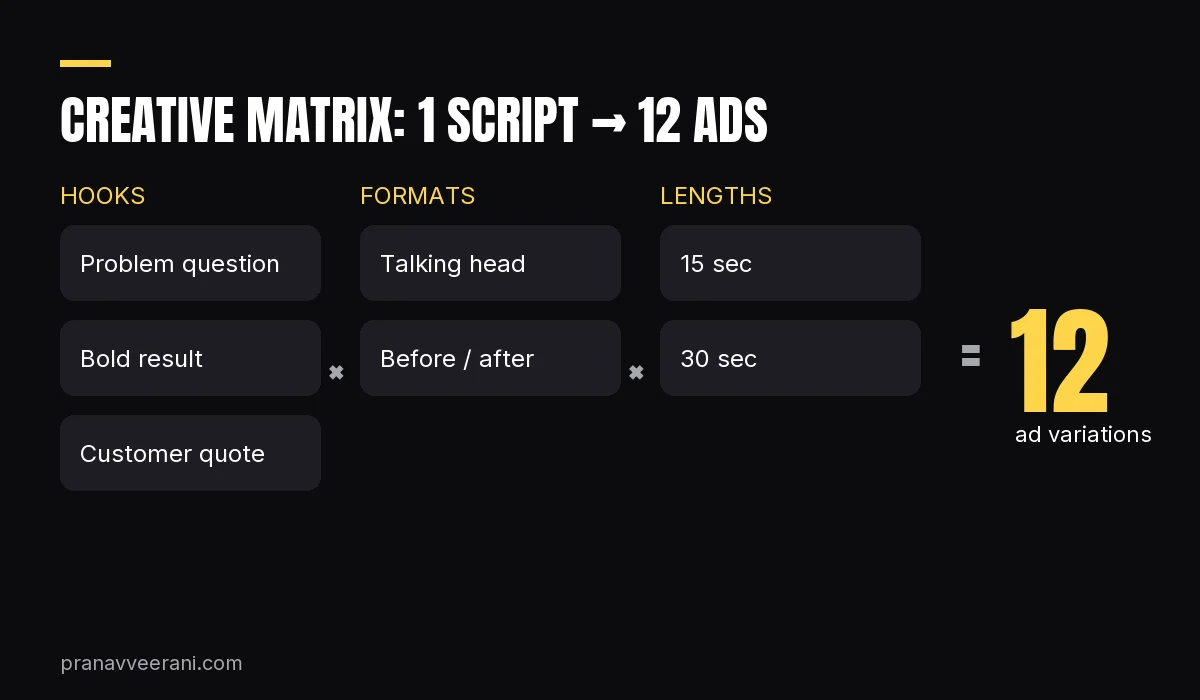
| Variable | Examples to test |
| Hook (first 3 seconds) | Problem question, bold result, customer quote, “Stop doing this” |
| Format | Talking head, product demo, before/after, text-on-screen, testimonial |
| Voice | Owner’s real voice, AI voiceover, captions only |
| Length | 6s, 15s, 30s |
| Call to action | Book now, WhatsApp us, get a quote, visit today |
Three hooks × two formats × two lengths gives you twelve focused variations from one script.
Step 3: Use AI where it saves time, keep humans where trust matters
- Scripts: use ChatGPT or Claude to draft hooks and scripts from the client’s real reviews, FAQs and offer.
- Visuals: combine real footage of the business (shop, team, work) with AI-generated B-roll, product shots or animated text.
- Voice and captions: AI voiceovers and auto-captions speed things up; most people watch with sound off, so captions are essential.
- Editing: AI editors can resize one video into 9:16, 1:1 and 16:9 for Reels, feed and YouTube.
Rule of thumb: at least one real element in every ad — the owner, the team, the location or a genuine customer. It’s what separates a local business from stock content.
Step 4: Launch a structured test
- Run variations in one campaign with a modest daily budget, so the platform can find winners.
- Judge early by thumb-stop rate and hold rate (how many watch the first 3 seconds and how long they stay).
- Judge final results by cost per lead or cost per booking, never by views alone.
- Pause clear losers after enough spend to be meaningful; keep two or three winners.
Step 5: Scale what works, and refresh before fatigue
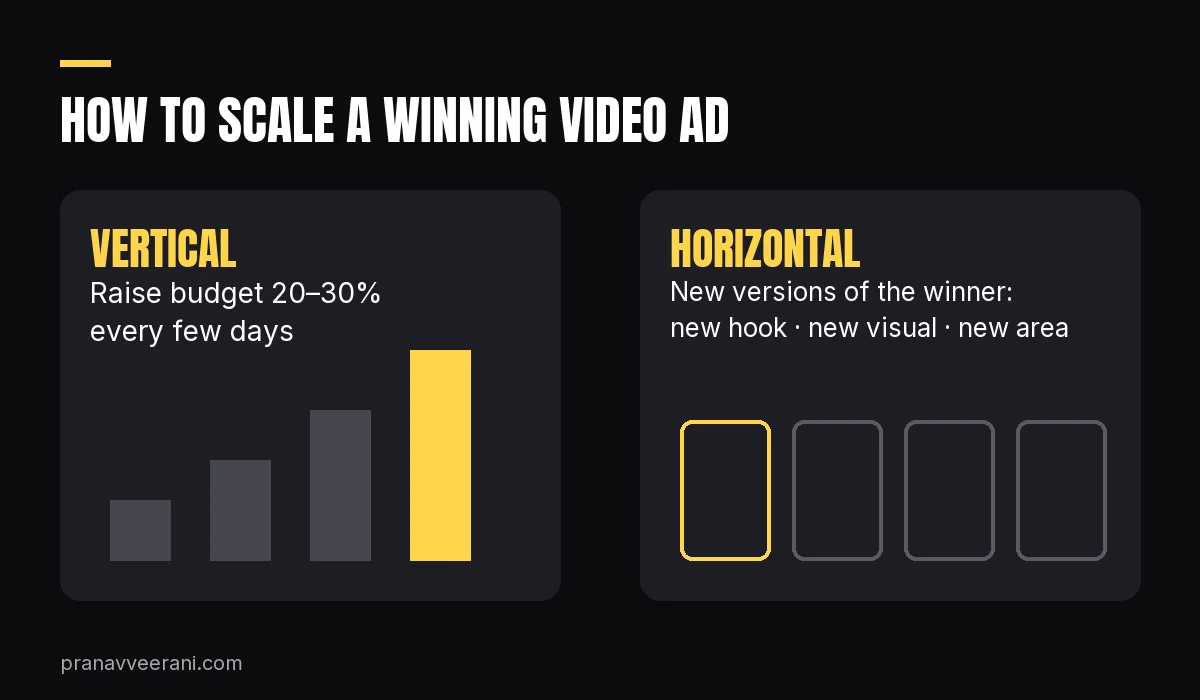
When a video brings leads at a good cost, scale in two ways:
- Vertical scaling: raise the budget gradually, around 20–30% every few days, and watch cost per lead.
- Horizontal scaling: create new versions of the winner — same hook with a new visual, same visual with a new hook, or local versions for nearby areas.
Watch frequency. When the same people keep seeing the same ad, results drop. Plan a fresh batch of variations every two to four weeks.
Step 6: Systemise it for every client
If you manage several small business clients, turn this into a repeatable workflow:
- A shared brief template: offer, audience, proof, objections, brand rules.
- A prompt library for hooks and scripts by industry.
- A weekly production batch and a fixed testing calendar.
- A simple report: spend, leads, cost per lead, best hook, next tests.
Automation tools can move briefs, scripts and finished videos between your team and the client, so approvals don’t slow everything down.
Common mistakes to avoid
- Publishing AI avatars that look fake and hurt trust.
- Making claims the client can’t back up. Keep results, prices and offers accurate.
- Ignoring platform rules on AI-generated content and disclosure where required.
- Sending traffic to a slow website instead of a focused landing page or WhatsApp.
- Scaling budget before tracking is set up.
Quick checklist
- One proven offer agreed with the client
- Creative matrix of hooks, formats and lengths
- Real footage plus AI production
- Captions and the right sizes for every placement
- Structured test judged by cost per lead
- Gradual scaling and a refresh every 2–4 weeks
Need help scaling video ads?
I help small businesses and agencies plan, produce and run video ads on Meta, Instagram and YouTube and Google Ads, measured by cost per lead. Start with a free website audit or book a strategy call.

About the author
Pranav Veerani
Digital marketing consultant and trainer in Ahmedabad with 10+ years of experience, 150+ brands served and 78,000+ leads generated. Founder of FSIDM and Unity Sangam, and guest faculty at Gujarat Technological University.